How Your Nervous System Controls Movement: From Brain to Muscle Contraction
We have spent a lot of time understanding the architecture of skeletal muscle, the sarcomere, the proteins, the force transmission…

By
March 5, 2026
We have spent a lot of time understanding the architecture of skeletal muscle, the sarcomere, the proteins, the force transmission chain from the inside of the cell all the way out to the bone. But none of that matters if the muscle never gets the signal to contract in the first place. So now we need to understand the system that delivers that signal: the nervous system.
This is one of those topics where seeing the big picture first makes everything else easier. So let’s start with the overall organization and work our way down to the specific pathway that leads to muscle contraction.
The Big Picture: Central and Peripheral
The nervous system divides into two major parts. The central nervous system, or CNS, is your brain and spinal cord. This is the command center. The peripheral nervous system, or PNS, is everything else: all the nerves that branch out from the brain and spinal cord to reach the rest of your body.
The PNS can be further divided based on the direction signals are traveling. Afferent pathways carry sensory information from your body toward the CNS. These are your sensory neurons. They tell your brain what is happening: what you are touching, where your limbs are in space, what temperature something is, whether a muscle is being stretched. Efferent pathways carry signals from the CNS outward to the body. These are your motor neurons. They tell your muscles and organs what to do.
This two-way communication is critical. Your brain does not just send commands blindly. It constantly receives feedback from sensory receptors throughout the body, processes that information, and adjusts its motor commands accordingly. The whole system is a loop.
The Efferent Side: Your Motor Nervous System
Since we are focused on how muscles contract, the efferent (motor) side of the PNS is where we want to spend our attention. And this side divides further into two branches: the somatic motor system and the autonomic nervous system.
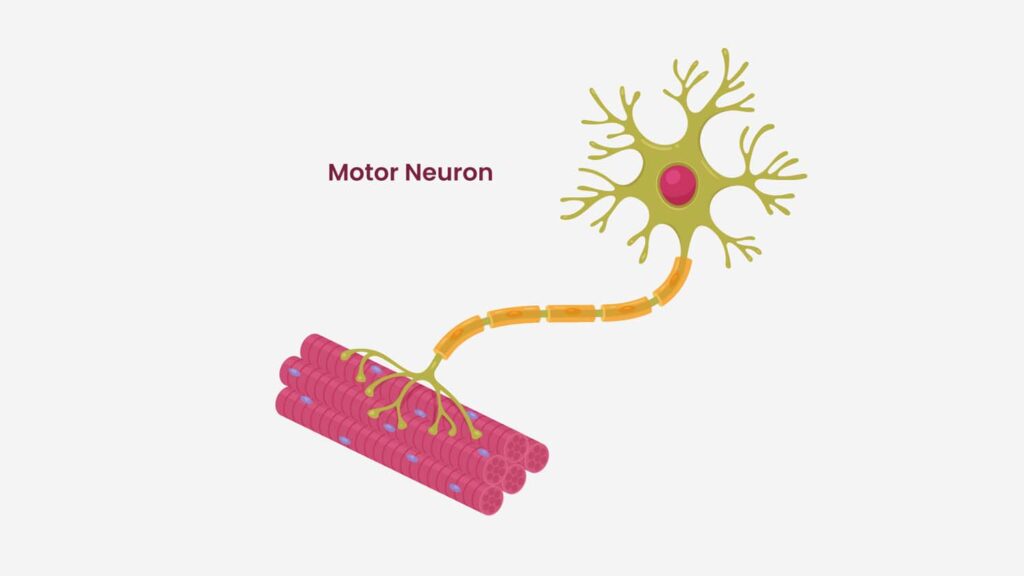
The somatic motor system controls voluntary movement. When you decide to pick up a glass, throw a ball, or take a step, you are using your somatic motor neurons. These neurons can be subdivided into two types. Alpha motor neurons innervate extrafusal fibers, which are your regular skeletal muscle fibers, the ones that produce force and movement. Gamma motor neurons innervate intrafusal fibers, which are the specialized fibers inside your muscle spindles. Muscle spindles are sensory organs embedded within your muscles that detect changes in muscle length. The gamma motor neurons adjust the sensitivity of these spindles so that your proprioceptive system stays calibrated as your muscles change length during movement.
For the purpose of understanding how movement happens, the alpha motor neuron is the key player. It is the final common pathway. No matter how complex the neural processing that happens upstream in the brain and spinal cord, the end result always comes down to an alpha motor neuron firing and telling a group of skeletal muscle fibers to contract.
The Autonomic Nervous System
The other branch of the efferent motor system is the autonomic nervous system, or ANS. This controls the things you generally do not think about consciously: heart rate, digestion, blood vessel diameter, glandular secretion.
The ANS has three subdivisions. The parasympathetic nervous system is your rest and digest system. It slows the heart rate, promotes digestion, and generally conserves energy. The sympathetic nervous system is your fight or flight system. It speeds up the heart rate, diverts blood flow to muscles, and prepares you for action. These two systems often work in opposition, like a gas pedal and a brake, maintaining a dynamic balance.
The third subdivision is the enteric nervous system, and this one is less commonly discussed but fascinating. Your gastrointestinal tract contains hundreds of millions of neurons. Hundreds of millions. It is sometimes called the second brain, and it is the basis of the gut-brain axis that has become such a prominent area of research. The enteric nervous system can operate semi-independently, coordinating digestion and gut motility on its own, though it communicates extensively with the CNS through both sympathetic and parasympathetic connections.
From Decision to Movement: The Signal Chain
So what actually happens when your brain decides to move? Let’s trace the signal from start to finish.
It begins with interneurons in the brain and spinal cord that process the intention and coordinate the motor plan. That plan gets transmitted through the PNS via efferent pathways to a somatic motor neuron, specifically an alpha motor neuron. The alpha motor neuron carries the signal from the spinal cord all the way to the skeletal muscle fibers it controls.
The way this signal travels is through action potentials. An action potential is a rapid electrical event that propagates along the length of a nerve fiber. It relies on a principle we have discussed before: the resting membrane potential. At rest, the inside of a neuron is negatively charged relative to the outside, around negative 70 millivolts. This is maintained by the sodium-potassium ATPase pump and the selective permeability of the membrane to potassium.
When a signal arrives, the membrane is depolarized. If that depolarization reaches a threshold, voltage-gated sodium channels open, sodium rushes in, and the membrane potential shoots positive. That is the action potential. It propagates down the entire length of the neuron like a wave, eventually reaching the terminal end of the alpha motor neuron at the neuromuscular junction.
At the neuromuscular junction, the action potential triggers the release of acetylcholine, which crosses the synaptic cleft and binds to receptors on the muscle fiber’s sarcolemma. This generates a new action potential in the muscle fiber, which travels along the sarcolemma and plunges into the T-tubules. The T-tubules carry the signal deep into the fiber, triggering the sarcoplasmic reticulum to release calcium. And once calcium is released, we are back to the territory we already understand: calcium binds troponin C, tropomyosin shifts, the myosin binding sites on actin are exposed, and cross-bridge cycling begins.
Why the Whole Loop Matters
It is tempting to think of movement as a one-way process. Brain sends command, muscle contracts, done. But the reality is that movement depends on constant feedback. Those sensory neurons we mentioned, the afferent pathways, are feeding information back to the CNS at every moment. Your muscle spindles report on muscle length and the rate of change. Your Golgi tendon organs report on tension. Receptors in your joints, skin, and other tissues contribute additional data.
Your brain integrates all of this sensory feedback and continuously adjusts the motor commands it sends out. This is why you can catch a ball that is thrown slightly off target, or adjust your grip when something is heavier than you expected. The entire system, motor and sensory together, works as a unified loop.
And this is also why understanding the nervous system matters for understanding muscle physiology. The sarcomere, the cross-bridge cycle, the force transmission chain, all of that incredible molecular machinery only operates because the nervous system tells it when and how to activate. The architecture of the muscle determines what it can do. The nervous system determines what it actually does.
Tyler W. LeBaron, MSc., PhD.
Tyler W. LeBaron, MSc, PhD is a is a researcher and educator who translates complex science into practical insight on health, performance, and human potential. He is the Founder and Executive Director of the Molecular Hydrogen Institute (a science-based 501(c)3 nonprofit) and an adjunct professor of exercise physiology and chemistry at Southern Utah University. Tyler is known for evidence-based, engaging presentations that challenge assumptions, clarify emerging science, and inspire high-performing individuals and organizations. He has 80+ peer-reviewed publications, 2,000+ citations, top 0.5% recognition in oxidative stress, and has delivered invited talks on six continents.
Disclaimer: This blog is for general informational purposes only and does not constitute the practice of medicine, nursing or other professional health care services, including the giving of medical advice, and no doctor/patient relationship is formed. The use of information on this blog or materials linked from this blog is at the user’s own risk. The content of this blog is not intended to be a substitute for professional medical advice, diagnosis, or treatment. Users should not disregard, or delay in obtaining, medical advice for any medical condition they may have, and should seek the assistance of their health care professionals for any such conditions.
You may also like these…